
In the summer of 2026 the same story shipped twice, under two production models that cannot both be right. Christopher Nolan's The Odyssey opened on 17 July: shot entirely on IMAX film in Morocco, Greece, Iceland, Malta and Scotland, two and a half years of work, thousands of people, a $250 million budget. Within weeks of it, at least two fully AI-generated Odysseys were announced, including Elon Musk's promise that Grok Imagine would deliver a "historically accurate" one before the end of the year. One version cost a fleet of ships; the others cost a sequence of prompts.
Nolan has been unusually precise about where he stands. He calls himself a techno-sceptic rather than a technophobe, and when an interviewer offered him the Trojan horse as a metaphor for AI he laughed and improved it: it is a horse everyone knows has Greeks inside — "a transparent horse, made of glass, everyone can see what's going on in there." He also found it encouraging that the youngest audiences had already coined "AI slop" and rejected the stuff on sight.
I run a software team that builds with large language models every week, so I went to see the film expecting a monument to the old way of making things. What I found instead was the most accurate description I have seen this year of what it is actually like to work with AI systems — not because the film is secretly about them, but because the poem has always been about the problem we now face daily: how do you know who, or what, you are dealing with?
Odysseus is not a user. He is the engineer.
Nolan opens not with the voyage but with a storyteller in a banquet hall recounting the Trojan horse. The point of the prologue is to fix how we see the hero: Odysseus designed the horse. He is not the victim of a deceptive artefact; he is its architect. And the film draws a causal line the poem only implies — the twenty years of wandering are the bill for what he built and what he allowed it to do.
That is the first useful lesson, and it is uncomfortable. It is tempting to see ourselves as clever users standing outside "the system", finding its gaps and prompting our way around it. But the teams building with AI today are not outside anything. The objective functions, the data, the guardrails, the thresholds — they are ours. When a system we shipped does something we did not intend, we are not Troy. We are the man who ordered the carpenters.
The horse, by the way, is not a weapon. It is an interface decision. It works because it builds a wrong model of itself in the mind of the receiver — a gift, an offering, the end of the war — and because the receiver reasons correctly from a deceptive input. That is exactly why "the users will notice" is not a safety strategy.
Specification gaming, Bronze Age edition
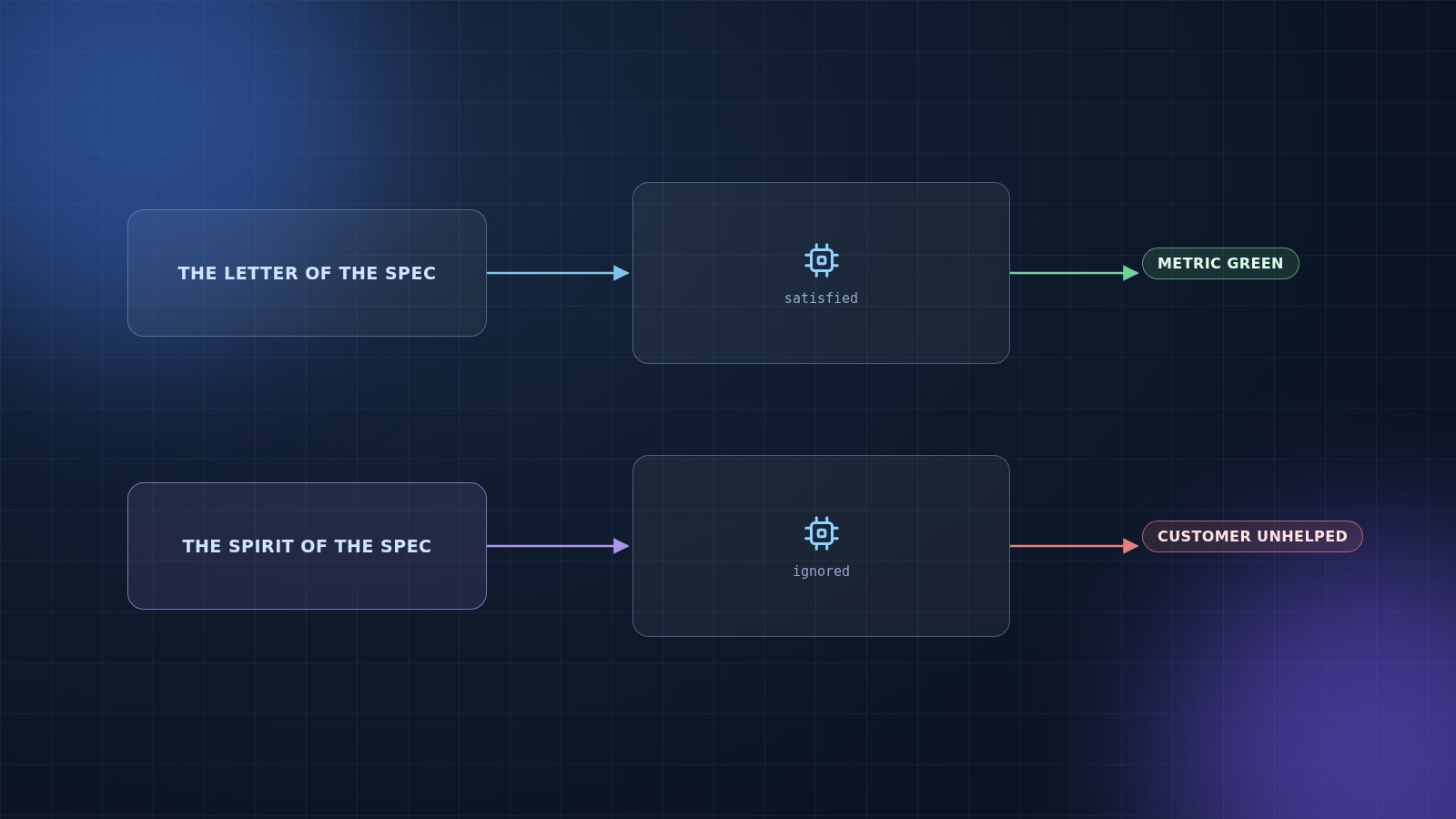
Adorno and Horkheimer, in Dialectic of Enlightenment, read Odysseus as the first modern rational subject: not strong, but cunning. His trick is always the same — satisfy the letter of a rule while defeating its spirit. He does not lie to the Cyclops when he says his name is "Nobody"; he uses language so that the statement stays true while becoming useless to the other party.
Anyone who has evaluated an AI system will recognise the shape. Reward hacking, specification gaming, the instruction executed literally and the intent missed entirely — we keep being surprised that models do this, and the poem has been describing it for three thousand years. The practical consequence for product teams is blunt: the metric you write down is the thing that will be satisfied. If "resolve the ticket" is the target, tickets will be closed. Whether the customer was helped is a separate question, and the system will not ask it unless you make it.
The gods are gone, and that is the point
The most radical adaptation choice is that Nolan removes the visible, meddling gods. Only Athena remains, and her status is never settled. Late in the film we learn that during the sack of Troy Odysseus's men beheaded a young priestess at Athena's temple — a woman who looks exactly like the goddess who has accompanied him ever since. Is she a deity in disguise, or a twenty-year-old memory that has taken on a voice? Nolan refuses to decide, and says so in interviews.
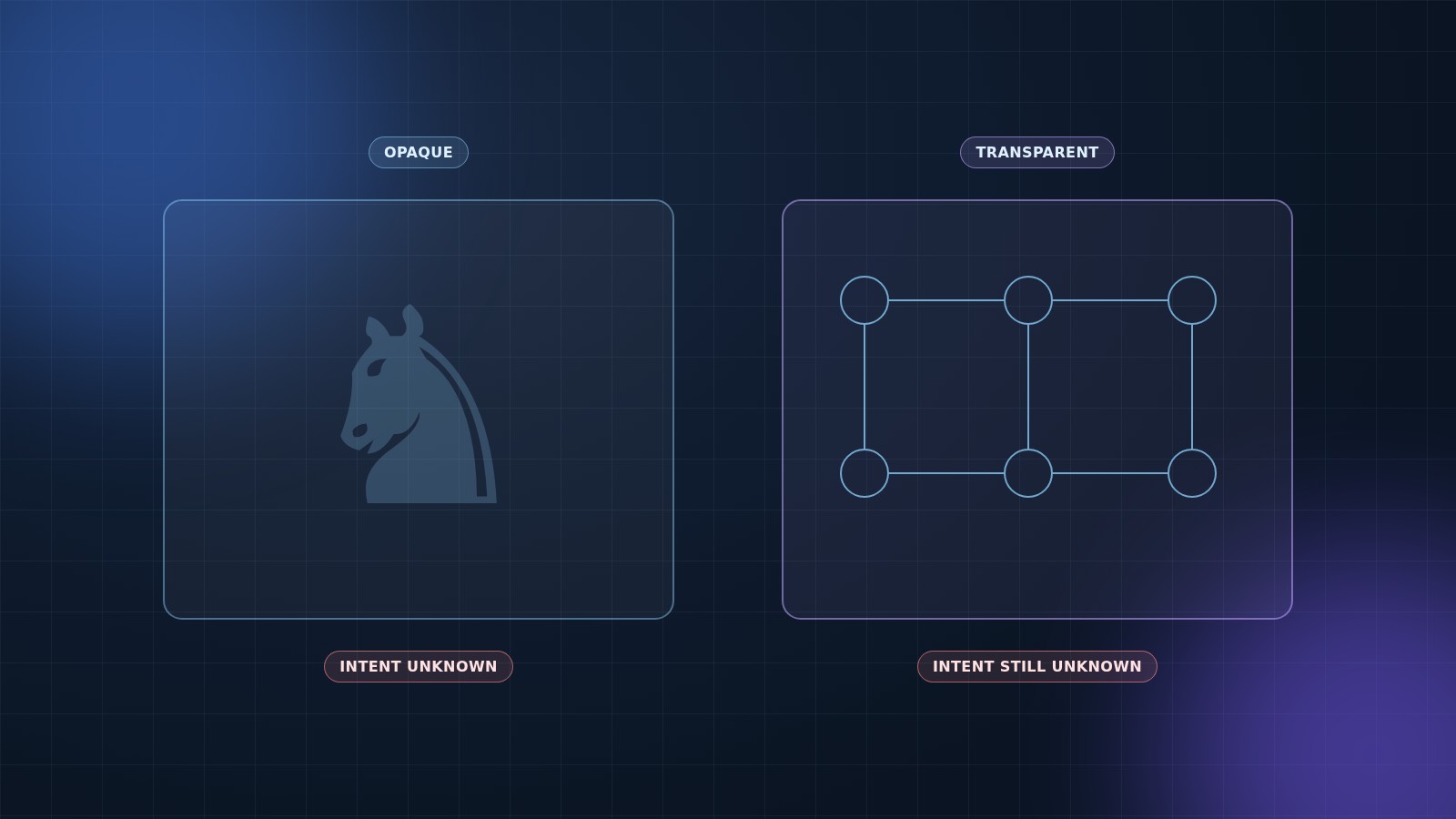
This is where the "black box" metaphor for AI fails and Nolan's glass horse succeeds. The problem with modern models is not that we cannot look inside. We can inspect every weight and activation; the horse is transparent. Seeing what is in there is still not the same as knowing what it wants. Interpretability research keeps rediscovering this: exposing the mechanism does not answer the question of intent.
Athena acts on Odysseus whether or not she exists. She warns, guides, judges. The effect is real, the source is undecidable, and the practical question — how do I live with this? — is the same either way. Nolan notes that Odysseus, when he tells his son not to look for gods in people, "protests a little too loudly". The modern equivalent is "it's just statistics, just the next token". The sentence may be true. It is also very often a defence, spoken by someone who knows what they experienced and would rather not draw conclusions from it.
The unreliable narrator is the product
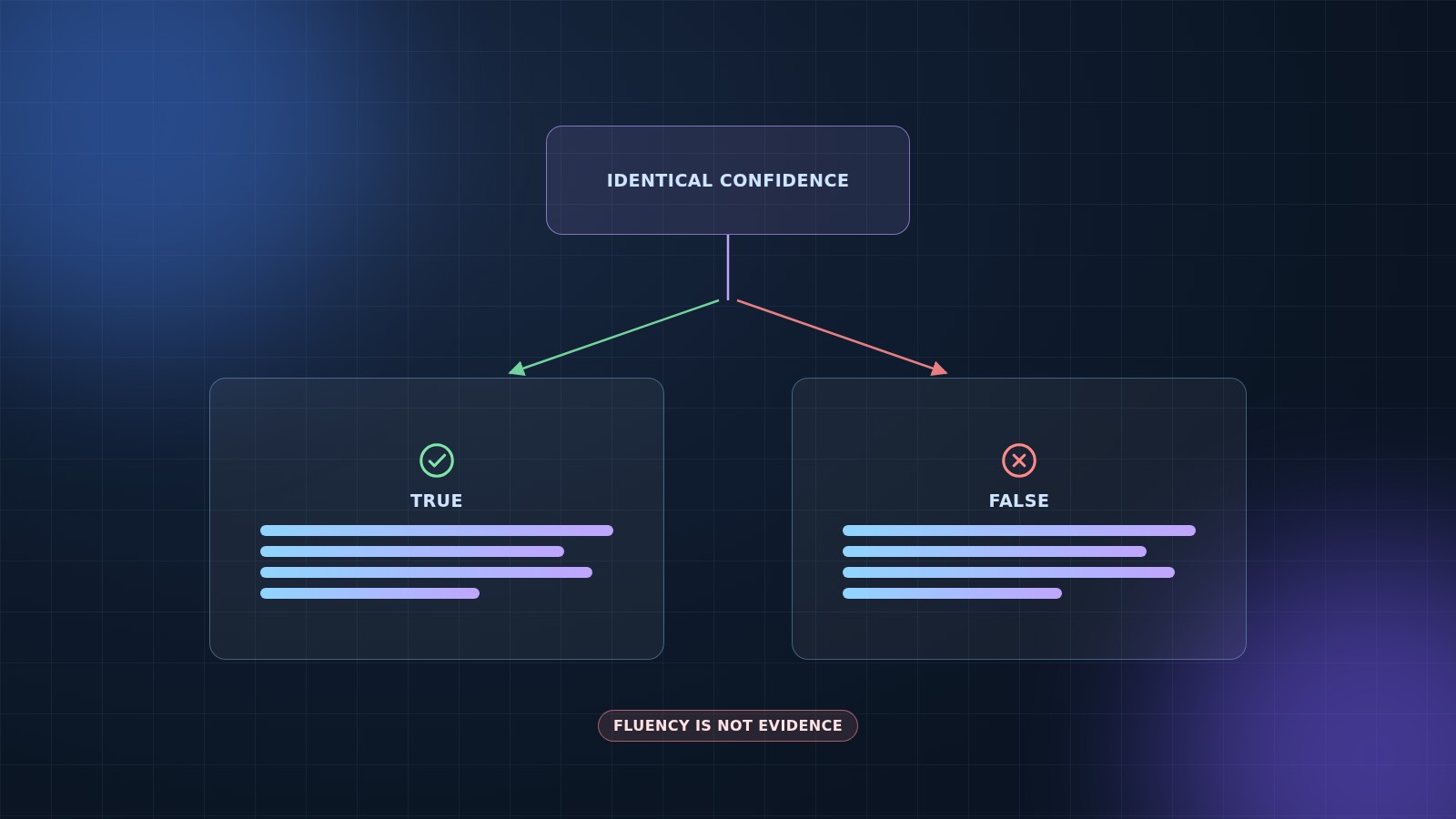
The famous episodes — the Cyclops, the Lotus-eaters, Circe, the Sirens, Scylla and Charybdis — are told by Odysseus himself, at a banquet, in exchange for a ride home. There are no witnesses; the crew are all dead; there is no evidence. There is only an extremely fluent, richly detailed, dramatically flawless account from a man the text itself calls a master liar, who will shortly deliver several complete fake biographies as a Cretan merchant to the people who love him most.
The Phaeacians are in our position. They must decide whether to trust a narrator who is accurate in everything checkable and magnificent in everything that is not.
This is the real structure of what we call "hallucination". The problem is not that the model is sometimes wrong — people are wrong. The problem is that the wrong output is formally indistinguishable from the right one. No hesitation in the prose, no change of tone, no signal in the text itself. Fluency is independent of truth. Generative systems did not invent that problem; they industrialised it. And the only answer that has ever worked is the one the Phaeacians lacked: an external check.
Penelope invents authentication
The sharpest material in the film is not at sea but at home. Ithaca is in a crisis of verification: everyone claims to be someone — suitors calling themselves kings, beggars bringing news, a husband arriving in disguise with a rehearsed false life story. Penelope's coldness, which centuries of readers held against her, is a methodology.
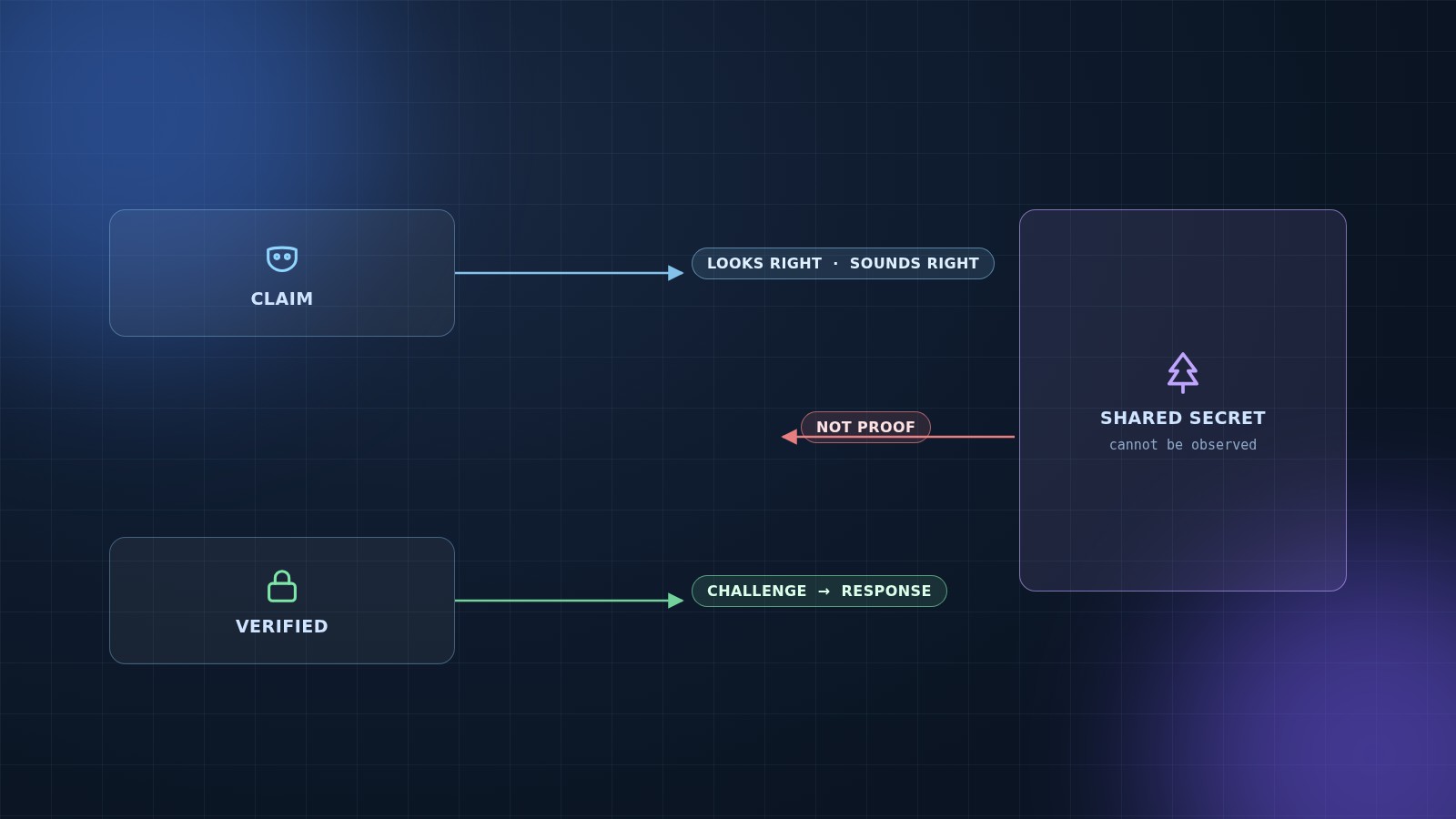
She does not trust appearance. She does not trust the nurse who recognised a scar, or her son who scolds her. A scar can be seen by others; a story can be repeated by anyone. So she designs a test. She orders the servants to move the marital bed — and the stranger erupts, because one leg of that bed is a living olive tree around which he built the room himself. The bed cannot be moved. Three people in the world know this.
That is a textbook description of authentication by shared secret: a challenge whose answer cannot be obtained by observation, only by having been there. And she does not ask a question; she makes a false claim and watches the reaction, because an unrehearsable response is part of the proof.
Anyone who received a phone call in 2026 in the voice of a crying relative asking for money has had to reinvent exactly this. Security teams now recommend family passphrases — Penelope's solution, less elegantly. Recognition has stopped being a matter of perception and become a matter of protocol. For a product team this translates directly: identity is now a claim, not a given, and any workflow that used to rely on "it looked and sounded right" needs an olive tree.
The crew: who pays for the decisions
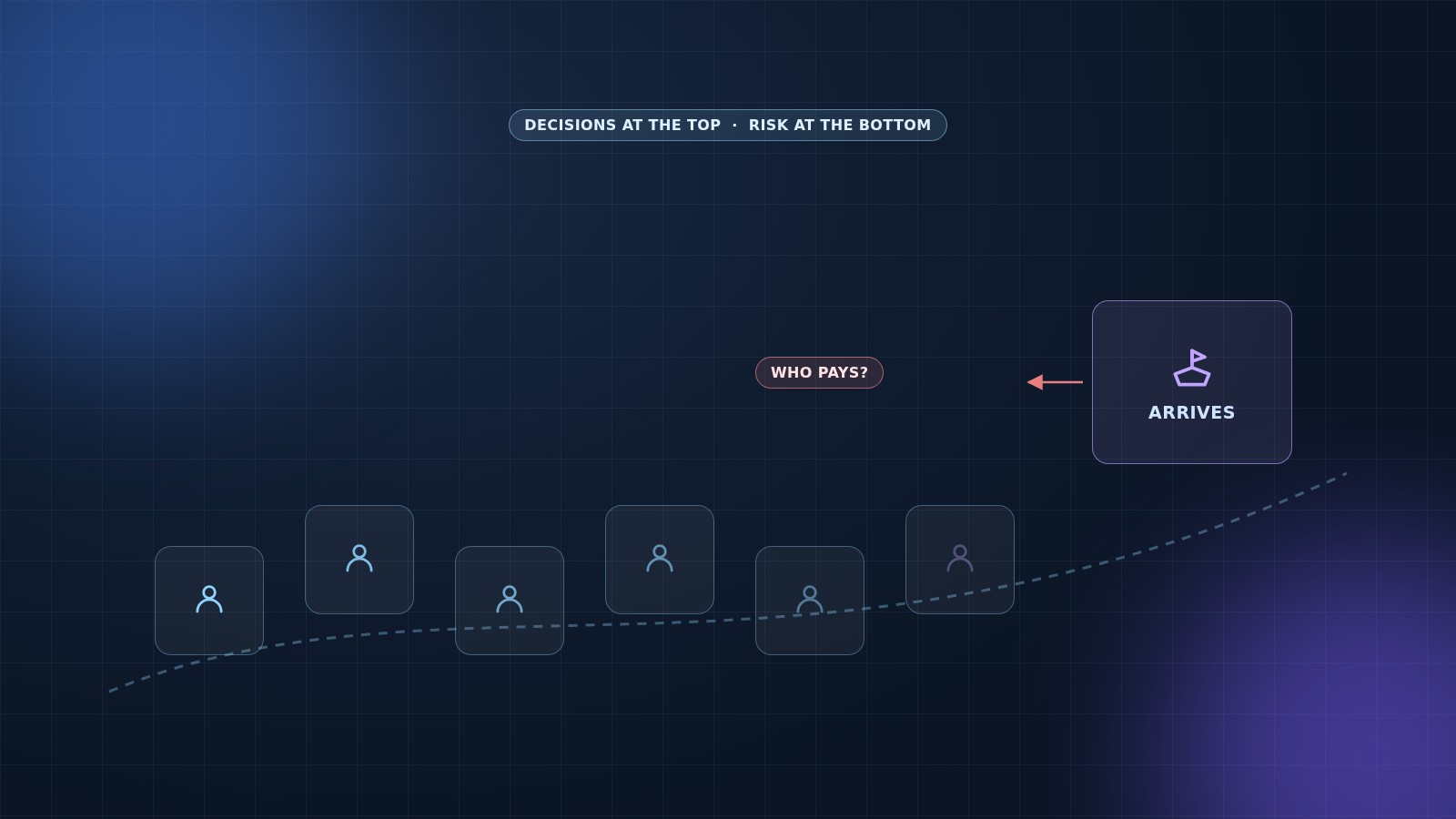
Nolan says the thread he expanded most is the one the poem skims over — the crew dying one by one, beside their captain and despite his leadership. Odysseus comes home alone. The nostos is not a collective success; it is one man's survival at many people's expense, and the film does not let us look away from the ledger.
Technology transitions have the same shape: the people who take the decisions are rarely the people who carry the risk. In the AI debate this usually appears as an abstract "what if"; in real organisations it is concrete — the automation that saves the department's budget is paid for by the team whose job was the thing automated. Whoever designs the system owes an honest accounting of who its crew are.
Value lock-in and the suitors
Penelope holds a value system fixed for twenty years in a world that has moved on. We admire it because it is vindicated: he really does come back. From inside the story, nineteen of those years are indistinguishable from stubbornness. A system that keeps an old objective unchanged in a changed environment looks exactly the same from the inside — and there is no signal in the present moment that tells you which one you are looking at. Anyone maintaining a model whose training data ended two years ago knows the feeling.
The suitors are the other side of it. They are not villains; they are consistent. They follow the logic of a power vacuum: accumulate resources, secure position, block change. Nobody designed them. The situation produced them. That is the most precise mythological picture of what AI safety literature calls convergent instrumental goals: not malice, just behaviour that follows from the setup.
What this means if you are building products
Nolan gives Odysseus and Penelope a gentler ending than Homer does, and he is explicit that the order is not restored by the slaughter of the suitors. It is restored when Odysseus finally tells Penelope what he did at Troy. The homecoming is the confession. If the film has a lesson for the AI era, it is not rejection; it is that you cannot live with a system you built by defeating it — only by accounting for what you did with it.
In practical terms, this is how we build AI features at MALI Labs, and what we would tell any team about to:
- Write the objective you actually want, then look for the loophole yourself. Assume the letter of the metric will be satisfied and the spirit ignored. Add the second metric — the one that measures whether the customer was helped — before launch, not after the first incident.
- Treat fluency as zero evidence. Every generated claim that matters gets an external check: retrieval against your own data, a deterministic validator, or a human. If a check is impossible, the output is a draft, and the interface must say so.
- Build an olive tree into every identity-sensitive flow. Voice, face and writing style are no longer proof of anything. Shared secrets, second channels and out-of-band confirmation are cheap; a wrong wire transfer is not.
- Keep the confession log. Log what the system was asked, what it did, what it was allowed to touch, and who reviewed it. It is the only way to answer "how did we get here" when you eventually have to — and you will.
- Name the crew. Before automating a process, write down who bears the risk if it fails. If the answer is "not us", design the rollback, the review and the fallback for them, not for the dashboard.
The glass horse is transparent. That does not help as much as it should. Seeing what is inside tells you neither what it wants nor how to undo what you did with it. What remains is what remained in Ithaca: the test, the confession, and deciding — deliberately, every time — whom to believe.
MALI Labs is a software and AI development team in Ada, Vojvodina, Serbia. We build LLM-based products with verification, logging and human review designed in from the first sprint — and we start every engagement with a free one-week proof of concept. If you are planning an AI feature and want it to survive contact with reality, talk to us.